Burkina Faso is an exception in the Sahel in that no politicisation and ideological radicalisation of Islam has taken shape in the public space. This paper – the first version of a chapter in an upcoming book – analyses both the causes and the implications of this fact. The historical analysis of the formative process of the Burkinabe nation reveals that Islamisation is a recent development in the country as compared to other parts of the Sahel. It came about as a result of the colonial transformation of societies in the area of future Burkina Faso, in the first half of the twentieth century and progressed in competition with Catholicism. While Islam later became the country's majority religion, the singular aspects of Burkina Faso's history – again, relative to its neighbours – have created a society marked by religious pluralism, and a very specific form of ‘consensual secularism.' In this context, an Islamic public space has emerged where various doctrinal currents – modernist reformists, Wahhabis, Sufis – struggle to assert themselves, but which leads to an enduring combination of subordination to and partnership with Burkina's successive regimes, especially as influential Muslim merchants largely control the all-important trade economy of the country. This result does not imply that Muslims in Burkina are politically quiescent, but that they tend to mobilise politically not as Muslims, but as citizens of Burkina, as is testified by the country's stormy political history. The case therefore teaches us to avoid essentialising Muslims' existence in the political arena.
Benin has a distinctive Islamic school system, constantly evolving since the colonial period: Besides the Coranic schools, which are still the basic instance of religious socialization, écoles arabes were established since independence, and furthermore there is an increase in écoles franco-arabes since the past ten years. This type of school combines religious and secular education. In the process of change in the educational system teachers are considered to be the key actors and initiators. This paper traces the development of the Islamic educational system by using the example of the city of Djougou in northern Benin. It aims to analyze the motivations of teachers in this arena and explores to what extent their self-image and their understanding of ′good education′ has changed. Particular attention will be paid to those teachers who are graduates from Islamic universities abroad. These so-called arabisants have access to strong social networks and use the existing educational structures to gain and maintain social and political influence,
The article, in a chronological manner, presents the academic literature from the initial studies on religions in Burkina Faso in the late 1950s to the present and according to the different subjects covered. The first part dis-cusses the classical works of anthropology of religion, the second part deals with historians' publications on pro-cesses of Islamisation and Christianisation in Burkina Faso. Finally, a third part analyses the publications that focus on religious diversity and contemporary religion as well as the comparative studies of Burkina Faso with other countries in the sub-region. The last part addresses the issue of radicalisation and its reception in research in religions in Burkina Faso. The common thread that runs through the different parts is the emphasis on the interactions between the political and religious situation of the country, researchers' interests and global interest in relations between Muslims and Christians. By way of conclusion, the article proposes a set of questions and initial interpretations that constitute opportunities for further research and new paths of exploration.
This text focuses on Turkey’s religious diplomacy in Côte d’Ivoire, a West African country where Islam has experienced significant growth in recent decades. Through the prism of a Soft Power, this cooperation opened Ivorian Islam – dominated by the Maliki and Salafi currents – to the religious tradition of Turkey. This process was marked by the transfers of practices as well as of religious objects, materials for the construction of mosques and support for socio-economic development initiatives. This study is mainly based on fieldwork carried out in Côte d’Ivoire (Abidjan, Bouaké and Korhogo) and Turkey (Istanbul). In addition, a digital ethnography conducted from social networks, in particular Facebook, was used.
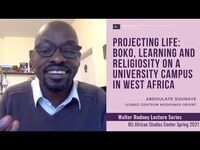
Si l’Université de Lomé, auparavant sous l’emprise du parti unique du Rassemblement du peuple togolais, est souvent perçue comme un haut lieu de la contestation parfois violente du pouvoir depuis le tournant des années 1990, elle est aussi caractérisée par une multiplication d’associations religieuses de différentes confessions. Cette communication propose de retracer l’histoire du militantisme islamique dans cet établissement d’enseignement supérieur laïc depuis la création de la Jeunesse estudiantine islamique de l’Université du Bénin dans les années 1980. L’engagement militant sur ce campus reflète, d’une part, les mutations plus larges qui ont caractérisé l’islam au Togo au cours des dernières décennies, dont le rôle joué par cette élite musulmane dans les débats politiques. D’autre part, il met en relief les défis auxquels font face les jeunes étudiant.e.s musulman.e.s en contexte minoritaire et autoritaire, qui sont exacerbés par la méfiance de l’État envers l’islam "politique" et les craintes plus récentes de l’extension du djihadisme aux pays côtiers du Golfe de Guinée.
Despite the growing popularity of digital humanities, a limited number of initiatives related to Islam in Sub-Saharan Africa have attempted to mobilize digital tools to analyze and disseminate research data. Launched in 2021, the Islam Burkina Faso Collection (https://islam.domains.uflib.ufl.edu/s/bf/) is an open-access digital database containing more than 2,700 archival materials, newspaper articles, Islamic publications, photographs and bibliographical references related to Islam and Muslims in Burkina Faso. “Digital exhibits” with interactive timelines, which include a selection of documents from the database, contextual information for approaching this material and a selective bibliography, serve as entry points for the larger collection. This project is one of the first digital humanities initiatives to be published under a new University of Florida Libraries program, LibraryPress@UF. This program, an imprint of the Libraries and the University of Florida Press, seeks to develop public scholarship across formats that extend and complement the work of traditional academic publishing. Alongside its value as a scholarly and educational resource, Islam Burkina Faso Collection has benefited LibraryPress as a case study to explore and refine three major areas: (1) publishing workflows and human resources, including evaluation of digital publications and multi-expert collaboration; (2) technical infrastructure and expertise, including defining services for web hosting and design; and (3) sustainability, including feasible expectations for maintenance and archiving. Throughout all of these areas, the project has modeled an approach to digital scholarship and library publishing that balances experimentation and ambition with realistic goals and an eye toward replicability in future work.
Despite the growing popularity of digital humanities, a limited number of initiatives related to Islam in Sub-Saharan Africa have attempted to mobilize digital tools to analyze and disseminate research data. Launched in 2021, the Islam Burkina Faso Collection (https://islam.domains.uflib.ufl.edu/s/bf/) is an open-access digital database published by the LibraryPress@UF, which contains more than 3,100 archival materials, newspaper articles, Islamic publications, photographs and bibliographical references related to Islam and Muslims in Burkina Faso. “Digital exhibits” with interactive timelines, which include a selection of documents from the database, contextual information for approaching this material and a selective bibliography, serve as entry points for the larger collection. In the medium to long term, the Islam Burkina Faso Collection will be part of a larger collaborative digital database on Islam in West Africa, which will include material that Frédérick Madore has already digitized as part of his research on Côte d’Ivoire, Benin, and Togo.
This talk explores the transformative impact of AI and machine learning on digital humanities research, with a focus on the Islam West Africa Collection (IWAC). It discusses progress in AI-assisted OCR for improved text searchability, and advanced NLP techniques including named entity recognition, topic modelling, and sentiment analysis. The presentation introduces the IWAC Chat Explorer, an AI-powered tool that searches the database, provides document context, generates responses and delivers citations. This innovation demonstrates how AI is revolutionising access to and interaction with historical collections, making them more discoverable and relevant for researchers and enthusiasts alike.
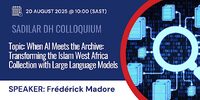
The Islam West Africa Collection (IWAC) comprises over 14,000 documents spanning six countries and containing 25 million words. This talk explores how large language models (LLMs) can transform vast collections into more navigable resources through three practical applications: enhancing OCR accuracy and entity recognition for African materials; conducting experimental sentiment analysis across over 10,000 newspaper articles on the representation of Islam; and developing a conversational AI chatbot that transcends traditional keyword searching. Drawing on my experience, I will present practical solutions for managing digital abundance while maintaining a critical awareness of AI’s inherent limitations.
La démocratisation récente des technologies d'intelligence artificielle (IA), caractérisée par une baisse spectaculaire des coûts et l'émergence de modèles open-source performants tels que Llama, transforme profondément les pratiques d'analyse des archives numériques. Cette communication propose d'examiner les applications concrètes et les enjeux de ces outils dans le cadre de la Collection Islam Afrique de l'Ouest (https://islam.zmo.de/s/afrique_ouest/), une base de données en libre accès regroupant plus de 10 000 documents sur l'islam et les musulmans dans six pays d'Afrique de l'Ouest.
Face à l'augmentation considérable du corpus au cours des dernières années (20 millions de mots), le traitement et l'indexation auparavant effectués manuellement sont désormais impossibles pour un projet piloté par une seule personne, ce qui nécessite une transformation profonde des façons de procéder. Les modèles "standards" de traitement du langage naturel, conçus principalement pour des contextes occidentaux, présentent des performances limitées pour la reconnaissance des entités africaines, ce qui compromet la fiabilité des analyses. Cette communication présentera des solutions innovantes basées sur l'IA et développées pour répondre à ces défis.
La présentation s'articulera autour de trois axes principaux :
1. L'élaboration de pipelines Python combinant différentes API de modèles d'IA pour automatiser le traitement des documents, notamment la reconnaissance optique de caractères (ROC), l'analyse des mises en page complexes d'articles de presse, qui est souvent problématique pour les outils traditionnels de ROC, ainsi que la reconnaissance d'entités nommées. Cette étape est cruciale pour toute analyse computationnelle en humanités numériques, car la qualité et la fiabilité des résultats dépendent directement de la précision de ces traitements initiaux. Un accent particulier sera mis sur l'optimisation des "prompts" pour chaque tâche spécifique, démontrant comment l'ajustement minutieux des paramètres permet d'obtenir des données structurées de meilleure qualité, qui sont essentielles pour les analyses ultérieures.
2. Les implications méthodologiques et éthiques de l'automatisation seront abordées, notamment les stratégies de validation, l'importance de la supervision humaine et les considérations éthiques liées au traitement d'archives sensibles. La discussion abordera également les défis techniques rencontrés et les solutions mises en place.
3. Le développement d'un chatbot basé sur une architecture de Retrieval Augmented Generation (RAG) peut transformer radicalement l'accès aux archives numériques. Alors que les recherches traditionnelles par mots-clés nécessitent une connaissance préalable du vocabulaire exact et limitent l'exploration aux correspondances strictes, ce système permet aux utilisateurs de formuler des questions complexes en langage naturel. L'architecture RAG ne se contente pas de rechercher des occurrences : elle analyse le contexte sémantique, établit des connexions entre les documents et génère des réponses synthétiques et documentées. Cette approche facilite la découverte de relations thématiques subtiles et de tendances historiques qui échapperaient aux méthodes de recherche conventionnelles, tout en maintenant une rigueur scientifique grâce à la référence systématique aux sources primaires.
Cette approche ouvre la voie à des analyses computationnelles à grande échelle permettant d'identifier des tendances et des relations qui seraient difficilement détectables manuellement. S'inscrivant dans l'axe "Intelligence artificielle (IA) : pratiques et cas d’usages en SHS" du colloque, elle propose un retour d'expérience concret sur l'utilisation de l'IA pour le traitement d'archives numériques dans un contexte africain.
The Islam West Africa Collection (IWAC) enhances transregional historical research, particularly in the study of Islamic networks and translocal entanglements across francophone West Africa. This open-access digital archive of over 8,800 documents from six countries fills gaps in the preservation and accessibility of post-colonial archives. Unlike well-organised European colonial archives, many West African national archives face budgetary constraints, resulting in fragmentary holdings and ineffective classification. The IWAC mitigates these challenges by digitising and organising diverse materials, in particular the rich (Islamic) print culture, providing insights into an “Islamic Francophonie”.
Using optical character recognition, natural language processing, and artificial intelligence, the IWAC enables researchers to uncover patterns of interaction and exchange across national boundaries. However, it also serves as a case study for critical reflection on digital approaches to global history. This paper will address concerns about the selectivity of digitisation programmes, including their potential to reinforce archival silences and biases. It will consider how algorithmic discovery and keyword searching can lead to the neglect of non-digitised or hard-to-access materials. It will also address criticisms of “digital imperialism” and the “digital saviour complex” in the context of projects funded by Western institutions.
This paper will contribute to discussions on how digital approaches impact our conceptualisation of historical connections, reflecting on the types of connections that digital methods can effectively uncover and those that may remain elusive. It will also explore how projects like the IWAC can address the challenges of the “digital divide” while avoiding the pitfalls of digital imperialism in global and transregional historical research.