Collection
Références (Niger)
- en
- fr
- Titre
- fr Références (Niger)
- en References (Niger)
- Description
- fr Livres, chapitres de livre, comptes rendus de livres, articles de revue, thèses, mémoires et rapports sur l'islam au Niger
- en Books, book chapters, book reviews, journal articles, theses, dissertations, and reports on Islam in Niger
- Couverture spatiale
-
Niger
- Identifiant
- iwac-collection-0000044
Contenus
-
BookPrayer Has Spoiled Everything: Possession, Power, and Identity in an Islamic Town of NigerBori, in the Mawri society of Niger, are mischievous and invisible beings that populate the bush. Bori is also the practice of taming these wild forces in the context of possession ceremonies. In Prayer Has Spoiled Everything Adeline Masquelier offers an account of how this phenomenon intervenes—sometimes subtly, sometimes dramatically—in human lives, providing a constantly renewed source of meaning for Mawri peasants confronted with cultural contradictions and socio-economic marginalization. To explore the role of bori possession in local definitions of history, power, and identity, Masquelier spent a total of two years in Niger, focusing on the diverse ways in which spirit mediums share, transform, and contest a rapidly changing reality, threatened by Muslim hegemony and financial hardship. She explains how the spread of Islam has provoked irreversible change in the area and how prayer—a conspicuous element of daily life that has become virtually synonymous with Islamic practice in this region of west Africa—has thus become equated with the loss of tradition. By focusing on some of the creative and complex ways that bori at once competes with and borrows from Islam, Masquelier reveals how possession nonetheless remains deeply embedded in Mawri culture, representing more than simple resistance to Islam, patriarchy, or the state. Despite a widening gap between former ways of life and the contradictions of the present, it maintains its place as a feature of daily life in which villagers participate with varying degrees of enthusiasm and approval. Specialists in African studies, in the anthropology of religion, and in the historical transformations of colonial and postcolonial societies will welcome this study.
-
Academic ArticleProcessus oblatifs à l'occasion de l'intronisation de chefs traditionnels en pays Hausa (République du Niger)La présente étude entre dans le cadre d'une analyse générale de l'économie traditionnelle en pays Hausa, dont quelques aspects ont déjà été présentés par ailleurs (i). Il s'agit ici de rendre compte de processus oblatifs qui se sont déroulés en 1962, 1965, et 1966, à l'occasion de la nomination de « chefs » traditionnels dans les cantons de « Bande », « Jirataoua », et dans la ville de « Maradi », en République du Niger. Les documents présentés ont été recueillis par nous-mêmes et deux assistants nigériens : MM. Habou Magaji, pour la région de Maradi, et Maman dan Mouché, pour le canton de Bandé. Les comptages ont été effectués par ces deux assistants au moment où étaient effectués ces dons, ou rapportés par les dignitaires qui en étaient chargés.
-
BookProfession : marabout en milieu rural et urbain. L'exemple du NigerLe maraboutisme est très présent dans la société contemporaine africaine, aussi bien en milieu urbain que rural. Si l'auteur de ce livre a eu des entretiens avec différents marabouts, il s'interroge sur la compréhension de leur histoire, leurs différentes activités dans la société, les relations qu'ils entretiennent avec leurs clients, les témoignages de ces derniers, et le déroulement de leurs travaux. Ce livre identifie les conditions de l'activité des marabouts au Niger, des origines à nos jours.
-
Personal CommunicationProjecting Life: Boko, Learning and Religiosity at a University in West AfricaWalter Rodney Lecture hosted by the Boston University African Studies Center, on April 26, 2021.
-
Academic ArticleQur'anic Exegesis in Niger: A Songhay-Zarma Oral Commentary on Sūrat al-BaqaraThe city of Saayi (Say), Niger has played an important role in the regional development of Islam from the early nineteenth century onwards. This paper traces its history and the biography of the founder, using the available written and oral sources, while also describing its role as a contemporary religious centre. The Qur'an is commented on in local languages both in the context of traditional advanced religious education and in Ramaḍān. The intellectual sources, language and ritual dimensions of enunciation of these oral commentaries are analysed, as are the ceremonies specific to Ramaḍān. Although Say was founded by Fulfulde-speaking scholars, reflecting the general cultural and social evolution of the city and its area, for the past 50 years, the Qur'an commentary in the Friday mosque has been given in Songhay-Zarma. While these commentaries are essentially based on recognised Arabic ones, their language makes some reference to the images and concepts of local Songhay-Zarma culture. The linguistic features and substantive content of Songhay-Zarma oral tafsīr are illustrated by two excerpts, each presenting several verses of Sūrat al-Baqara: one is drawn from a full tafsīr collected in Say in 1968, at the initiative of the well-known statesman and man of letters Boubou Hama; the other was collected in the Zarma country in 1905–6.
-
Academic ArticleReflections on Slavery, Seclusion and Female Labor in the Maradi Region of Niger in the Nineteenth and Twentieth CenturiesThis essay argues that female participation in agriculture and limited seclusion in Maradi (Niger) today do not stem from the absence of agricultural slavery in the pre-colonial period but rather result from the resistance of the Katsinawa élite to the Islamic reforms of the Sokoto Caliphate and from the absence of rimji (plantation) slavery in the region. The abolition of slavery did not mark a watershed in the rise of seclusion, as M. G. Smith argues was the case in Nigeria, but rather triggered a series of reformulations of marriage and female hierarchy. Semi-legitimate and legitimate polygynous marriages permitted men and women of the wealthier classes to retain the labor of former female slaves as ‘concubines’ and later enabled them to use junior wives to perform the duties once carried out by slaves. Women countered the ambiguities of such marriages by asserting their worth through wedding ritual and later by adopting the veiling of élite women. As economic and cultural ties with northern Nigeria grew during the colonial and post-colonial periods, and as goods and services reduced some of the labor demands upon urban women, seclusion gained in popularity. By acquiescing to the dependency implicit in purdah women could protect themselves from the labor demands of others and could sometimes free themselves up to earn independent incomes of their own. Thus the recent adoption of seclusion in Maradi has not arisen out of a unilateral decision on the part of newly freed women to adopt seclusion as a sign of status, as Smith claimed for Northern Nigeria, but resulted instead from of a series of redefinitions, contestations and negotiations of marriage in which both men and women have been active.
-
Academic ArticleReinterpreting the Role of Muslims in the West African Middle AgesRecent research points to a renewed scholarly interest in the West African Middle Ages and the Sahelian imperial tradition. However, in these works only tangential attention is paid to the role of Muslims, and especially to clerical communities. This essay tackles theoretical and historiographical insights on the role of African Muslims in the era of the medieval empires and argues that the study of Islam in this region during the Middle Ages still suffers from undertheorizing. On the contrary, by using a ‘discursive approach’ scholars can unravel access to fascinating aspects of the history of West African Muslims and in particular to the crucial role played by clerical communities, who represented one node of the web of diffused authority which is characteristic of precolonial West African social and political structures.
-
ReportReligion, demande sociale et réformes éducatives au NigerDans beaucoup de pays de l’Afrique sub-Saharienne, l’éducation – comme bien public – a été mal délivrée, et sa qualité a décliné de manière parfois remarquable durant la période postcoloniale. Cette situation s’explique en partie par le fait que dans plusieurs pays du continent – et peut être surtout en Afrique Francophone – les structures institutionnelles du système éducatif héritées de la colonisation s’accommodaient difficilement à la demande sociale et aux réalités culturelles. C’est peut-être ce qui explique que les politiques éducatives ne semblent pas contribuer au développement. Dans les pays à majorité musulmane du Sahel, une des réponses de la société à la mauvaise «articulation» entre l’offre éducative publique et la demande sociale a été le développement d'un vaste système parallèle d’éducation informelle alimenté par la religion. Ce système a évolué en dehors des cadres éducatifs officiels et a constitué une réponse explicite aux déficits de l’offre éducative formelle de l'État. Ces écoles non-officielles, “informelles”, ou “parallèles” se sont développées sous des formes et à des niveaux très variés, allant des écoles coraniques simples aux “écoles franco-arabes” assez bien sophistiquées. En les voyant comme des concurrentes du système éducatif officiel, les Etats ont tenté de confiner, contrôler, ou bien parfois d'ignorer ces instances éducatives alternatives au cours des trois premières décennies des indépendances. Il est vrai que les politiques éducatives ont joué différemment dans chaque pays couvert par cette présente étude. Mais partout, des histoires abondent sur les efforts du gouvernement visant à forcer les enfants à fréquenter les écoles officielles de l'État, et sur les stratégies et ruses déployées par les parents pour résister. Comme l’a si bien noté Louis Brenner dans ses enquêtes sur la politique éducative du Mali il y a vingt ans, le thème sous-jacent de l'histoire racontée est celui d’un « conflit acharné entre la politique du gouvernement et une opposition à cette politique exprimée par la voie de l'éducation islamique » (Brenner 1991, 84). Toutefois, suite aux modifications graduelles mais significatives du contexte de la gouvernance aussi bien au niveau domestique qu’international qui ont marqué les deux dernières décennies, un certain nombre de facteurs ont poussé un large éventail de pays Africains à se lancer dans des expériences de réforme de l'éducation. Ces évolutions ont suscités une attention renouvelée de la communauté internationale sur l'éducation en tant que facteur clé de développement. Dans le contexte des pays francophones et musulmane du Sahel, l’un des aspects frappants du processus de réforme a été les tentatives d’amener l’éducation religieuse informelle et semi-formelle dans le giron du système étatique formel, ou – à défaut – de réformer le système formel en y incorporant des caractéristiques propres à l’éducation informelle. C’est par exemple le cas avec l'introduction de l'enseignement religieux dans les écoles publiques dans certains pays à majorité musulmane du Sahel. Il y a un débat ancien sur la relation entre la religion et les politiques éducatives dans la sous-région, tout comme il y a des débats parallèles en cours ailleurs dans les pays du monde Musulman. Mais compte tenu de l’attachement persistant des Etats postcoloniaux du Sahel à l'éducation francophone à caractère laïc, ces efforts de réforme actuels sont sans précédent. Bien qu’elles soient encore en développement, et même si leur impact à longue terme n’est pas encore tout à fait observable, le fait seulement d’entreprendre ces réformes marque une rupture importante par rapport à la politique éducative historique dans la sous-région. Le secteur de l'éducation est donc un exemple clé de la façon dont l'intersection entre la libéralisation politique au nom de la démocratie et les contextes sociaux changeants au cours des deux dernières décennies ont permis– et parfois motivé – des changements politiques visant la réforme des institutions et l’ajustement des politiques à la demande sociale (Villalón, 2010). Le projet “Religion, demande sociale, et reforme éducative au Sahel” du programme Afrique Pouvoir et Politique (APPP) a permis d’entreprendre une recherche comparative sur les politiques de réforme de l’éducation dans trois pays du Sahel – Niger, Mali et Sénégal – qui sont tous assez bien avancé dans la mise en œuvre de ces réformes éducatives. Dans chacun de ces trois pays, la justification courante de la réforme est l’argument selon lequel rendre les établissements d'enseignement plus en phase avec les réalités locales et les attentes sociales—et non à leur encontre— est essentiel pour corriger la tendance au déclin de l’éducation. Dans la terminologie des hypothèses de l’APPP, ces efforts de réforme constituent des changements institutionnels délibérément façonnés “to go with the grain” (pour aller dans le courant) des réalités sociales africaines (Booth, 2011). En d’autres termes, les réformes permettent d’ajuster les politiques éducatives aux préférences très manifestes et aux normes culturelles très dominants des parents dans les pays musulmans du Sahel. Dans tous les trois pays, les projets de réforme menés par l'Etat ont tenté d'intégrer ou de «capturer» les systèmes éducatifs qui florissaient dans l'informel, tout en essayant de leur imposer un certain degré de formalisation. Une telle approche a conduit ainsi à la création de ce qui pourrait être considéré comme de nouveaux systèmes “hybrides.” Ces réformes ont été eux-mêmes rendu possible grâce aux changements dans la nature de l'Etat et de la relation État-société en cours depuis les années 1990. A bien des égards, les arguments avancés pour conduire la réforme dans ces pays étaient impensables au cours des décennies précédentes. Ces nouvelles initiatives ont été rendues possibles et promues par des acteurs clés qui ont saisi l’opportunité offerte par les changements du cadre de la gouvernance, lesquels changements sont eux-mêmes le résultat des transformations sociétales graduelles et progressives mis en marche au cours de la phase de libéralisation politique des années 1990. Ce présent projet de recherche visait à examiner de près à la fois les dynamiques parallèles et les similitudes dans le processus de réforme dans les cas précités, tout en mettant en exergue les variations et les spécificités propres à chaque pays. Le projet est le fruit d’une collaboration entre le Centre d'Etudes Africaines de l'Université de la Floride et le Laboratoire d'Etudes et de Recherches sur les Dynamiques Sociales et le Développement Local (LASDEL) à Niamey. Il est codirigé par Leonardo A. Villalón et Mahamane Tidjani Alou. L'idée du projet est née d’une première série d’entretiens réalisés dans les trois pays par Villalón en 2008. Ce travail exploratoire a permis d’apprécier la grande pertinence de ces réformes éducatives pour les préoccupations théoriques de APPP. Sur cette base, une réunion initiale s’est tenue en Juin 2009 au LASDEL, entre les codirecteurs et Abdourahmane Idrissa (qui devait coordonner la recherche) pour planifier le travail de terrain. Une équipe de recherche composée d’assistants de terrain dans chaque pays (Mamadou Bodian pour le Sénégal; Issa Fofana pour le Mali, et Ibrahim Yahya Ibrahim pour le Niger) a travaillé avec Villalón et Idrissa pour conduire à la fois des entretiens avec les acteurs clés et faire des observations ethnographiques sur un échantillon d'écoles dans chaque pays en 2009-2010. Au Niger, d'autres études ethnographiques ont été réalisées dans différentes écoles par Ali Bako, Issa Tahirou, et Mokhtar Abdourahmane, sous la direction de Tidjani Alou. En Juin 2010, toute l'équipe de recherche s’est réunie à LASDEL pour un séminaire de trois jours, afin d’étudier les résultats empiriques de la recherche, dans le but de préparer la rédaction des rapports. Ainsi, les expériences du projet de réforme dans chacun des trois pays sont examinées dans trois rapports séparés, dont ce présent rapport. En outre, un aperçu global de la question dans les trois pays est à paraitre (Villalón, 2012). Nous envisageons une analyse comparative plus approfondie des implications des trois expériences de réforme éducative en rapport avec les préoccupations plus larges du projet APPP dans le travail à venir. Le présent rapport explore le processus de réforme pour le cas du Niger en situant cette réforme dans l'évolution du contexte social et politique du pays. Il décrit la marginalisation historique du secteur franco-arabe, officiellement reconnu (à la différence avec les autres pays) mais qui a toujours été le « le parent pauvre » du système éducatif. Longtemps tenaillées la laïcité d’Etat et une forte demande en éducative religieuses, le rapport examine en particulier comment les franco-arabes ont pu être réhabilitées, à partir des années 1990, comme alternative éducation. Ce changement est impulsé par une démocratie naissante, de fortes pressions des populations fortement Islamisées, et des réformes éducatives respectives de 1994 et 1998. Le rapport examine ensuite les mesures de réforme spécifiques qui ont été adoptées, et les tendances sociales observables de ces réformes. Il examine aussi les différents problèmes rencontrés dans la mise en œuvre de la réforme.
-
Academic Article
-
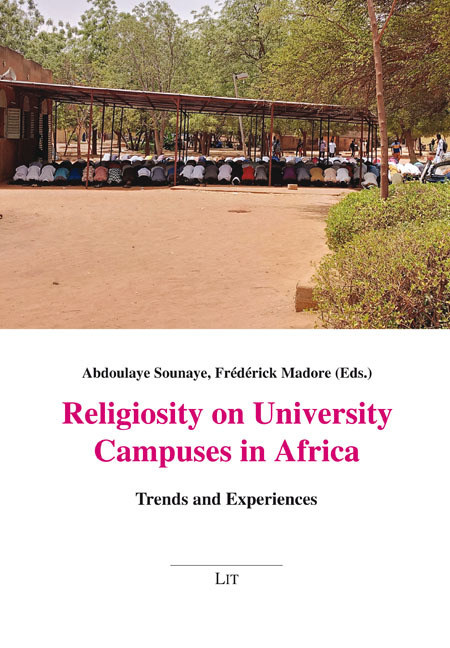
Edited BookReligiosity on University Campuses in Africa: Trends and ExperiencesThis volume examines religiosity on university campuses in Sub-Saharan Africa. Focusing on both individuals and organized groups, the contributions open a window onto how religion becomes a factor, affects social interactions, is experienced and mobilized by various actors. It brings together case studies from various disciplinary backgrounds (anthropology, sociology, history, religious studies) and theoretical orientations to illustrate the significance of religiosity in recent developments on university campuses. It pays a particular attention to religion-informed activism and contributes a fresh analysis of processes that are shaping both the experience of being student and the university campus as a moral space. Finally, it sheds light onto the ways in which the campus becomes a site of a reformulation of both religiosity and sociality.
-
Academic ArticleReligious Violence and Democracy in NigerDeadly attacks on Christians and mounting resistance to secularism in Niger raise the question of whether the Muslim-majority country is turning away from democracy and toward a repressive form of Shari'a law. I argue that religious extremism in Niger has largely external roots and that domestic religious leaders are not pursuing a revolutionary agenda, even though they are increasingly involved in organizing social movements. The foreign nature of terrorist threats may even help preserve democracy by raising nationalist support for the state.
-
Academic ArticleRevolutionary Mahdism and Resistance to Colonial Rule in the Sokoto Caliphate, 1905–6The Mahdist uprising of 1905–6 was a revolutionary movement that attempted to overthrow British and French colonial rule, the aristocracy of the Sokoto Caliphate and the zarmakoy of Dosso. The Mahdist supporters of the revolt were disgruntled peasants, fugitive slaves and radical clerics who were hostile both to indigenous authorities and to the colonial regimes. There was no known support among aristocrats, wealthy merchants or the ‘ulama. Thus the revolt reflected strong divisions based on class and, as an extension, on ethnicity. The pan-colonial appeal of the movement and its class tensions highlight another important feature: revolutionary Mahdism differed from other forms of Mahdism that were common in the Sokoto Caliphate at the time of the colonial conquest. There appears to have been no connection with the Mahdists who were followers of Muhammad Ahmed of the Nilotic Sudan or with those who joined Sarkin Musulmi Attahiru I on his hijra of 1903.
-
Academic ArticleSalafi Aesthetics: Preaching Among the Sunnance in Niamey, NigerIn their effort to contribute to Islamic reform in Niamey, young Salafi (Sunnance) have embraced preaching and have made it part of their religious practice. As preachers or audience members, they invest time and energy to imagine various ways to popularize the Sunna, the tradition of the prophet Muhammad. Because of the jokes, mimicry, and theatrics that characterize their preaching style, their critics have rejected their initiatives, claiming they are unqualified and therefore should not be allowed to preach. In response, Sunnance have argued that an effective sermon (wazu) requires art, skills, ingenuity and know-how (iyawa, hikma in Hausa). By examining how aesthetics are central to Sunnance popular and street preaching, this article invites a reexamination of Salafism through its aesthetic forms. Wazu is not just a gathering that seeks to deliver a message, be it divine; it is also a way to promote religiosity through particular cultural and aesthetic performances.
-
blog postSalafists and the Missing State in the SahelIn the 1960s, there was an African ambition to build modern states based on ‘national development’. But in the late 1980s, national development was dismissed - in most cases under compulsion from the international financial institutions. And without national development project, there are really no states in Africa, only regimes. In the Sahel, this paved the way for the establishment of the ‘Islamic state’.
-
Academic ArticleSecular Power and Religious Authority in Muslim Society: The Case of SonghayThe relationship between political power and religious authority has been a delicate one in Muslim societies. On the one hand, governments may attempt to silence religious authorities; on the other, they may themselves succumb to revolutions in the name of religion. More often governments have attempted to co-opt religious authorities as allies in exercising control or have worked directly in a power-sharing arrangement with them. In Songhay, as in several other states of pre-colonial Sudanic Africa, a more subtle balance was achieved between the ruling estate and the diverse body of scholars, mystics and holymen who made up the religious estate. The askiyas of sixteenth-century Songhay, while exercising full political power, saw it in their interest to maintain harmonious relations with these men of religion. Gifts in cash and kind, including slaves, grants of land and privilege, especially exemption from taxation, as well as recognition of rights of intercession and sanctuary, ensured their moral support and spiritual services and, importantly, protected rulers from their curse. Such a symbiosis was important for the stability of a large and ethnically diverse empire like Songhay, especially as regards its conquered western reaches, which were ethnically non-Songhay and had a strong Islamic cultural tradition. This delicate balance was upset by the Sacdian conquest of Songhay in 1591. Despite Moroccan assertions of Islamic legitimacy, religious authorities in Timbuktu were unsupportive, and harsh measures against them dealt a lasting blow to the equilibrium which had prevailed under the askiyas.
-
Academic ArticleSecular States, Muslim Law and Islamic Religious Culture: Gender Implications of Legal Struggles in Hybrid Legal Systems in Contemporary West AfricaThis article sets out the differing approaches of three West African states (Niger, Senegal, and Nigeria) towards reconciling the multiple legal systems (Islamic, western, military) they have inherited as ostensibly secular states in regions with prominent Muslim populations. While Senegal has adopted a Family Code that appears to modify and regulate some of the perceived injustices of Islamic law in family life, a number of states within Nigeria have gone in the opposite direction, expanding Islamic law beyond family law into the criminal domain. In Niger, on the other hand, multiple systems of law co-exist uneasily, without any effective hierarchy or definitive conclusion to legal disputes carried into different legal domains. In all three cases the state does not have the capacity to effectively enforce a single coherent legal system, nor does it succeed in controlling the «justice» that so commonly occurs in extra-legal settings. Throughout West Africa legal reform must contend with the dual problems of weak state capacity to impose a unified legal system and of the vigilantism of pressure groups that may have limited mastery of the Islamic juridical tradition in an atmosphere that is nevertheless heavy with the rhetoric of a return to Islamic purity.