 Islam. Nuit du Maouloud : la communauté musulmane soutient l'accord de Ouaga
  Islam. Prédicateurs : charlatans ou devins?
  Islam. Rentré récemment des États-Unis : le Cheick Fofana officie sa première prière publique
  Islam/Femme musulmane et procréation : le planning familial comme moyen de stabilité du foyer
 Until 1993 the government-approved Association islamique du Niger (AIN) was the sole Islamic association in Niger. However, with the transition to a democratically elected government came reforms in the areas of freedom of speech and expression. With this transition came the formation of the Association nigérienne pour l'appel et la solidarité islamiques (ANASI), the Association pour la diffusion de l'islam au Niger (ADINI), the Association pour le rayonnement de la culture islamique (ARCI) and the Association des jeunes musulmans du Niger (AJMN). From November 1994 to April 1995 the author conducted research on Islamic culture and practice in Zinder, the second largest city of Niger. The present article is based on the author's interviews with members of these associations in Zinder as well as on the associations' statutes. It outlines the philosophy, objectives, organization and resources for each association. The similarities in the objectives of these associations seem to contrast with the wide range of variation in Islamic culture and practice in Zinder. These associations, while each arguing for the oneness of their religion, also represent a major difficulty facing Muslims in the world today, which is the attempt to present a unified religion in the face of cultural variation in the way people interpret and practice Islam.
In Zinder (Niger), Islam is a resource that has always been contested, as a historical perspective demonstrates. Since the mid-19th century, Islam has been contested by 'sarki'-s ('sarki' is the Hausa word for sultan), by advisors to the 'sarki', by members of the Qadiriyya, Tijaniyya and Sanussiyya, who sought to establish and develop large, well organized centres in Zinder, and even by the French. In the 1950s followers of Ibrahim Niasse attempted to establish a centre in Zinder. As in the case of previous such attempts, the 'sarki' was unreceptive. At the end of the 20th century, reformers are attempting to redefine Islam as they challenge Islamic practice and Muslim identity as defined by the 'malamai' (Koranic scholars) and majority Muslims in Zinder. Always present in the debate are the 'bokaye' (traditional healers) and those who continue to incorporate local practices into their practice of Islam.
The West African territory that would eventually become Côte d’Ivoire was long considered a land where Islam was destined to remain marginal. This perspective was based on the region’s social and geographic characteristics, namely a southern forest region tending more toward African “traditional” religion but increasingly Christianized, and a Muslim population limited to some parts of the northern region. By contrast, early twentieth-century research undertaken by Paul Marty (...
The Islamic State's emergence in the Sahel region has triggered violence resulting in a large-scale refugee crisis. This paper focuses on the instability and refugee situation in Burkina Faso, which has received less attention than other Sahel countries such as Mali and Nigeria. In academic debates, IS-instigated terrorism tends to be examined as a multi-layered conflict with non-religious reasons in the background. However, religion is a key factor fueling terrorist activity in the Sahel region and determining its outcome, as the idea of creating an Islamic State or caliphate is inherently religious in nature. Islamic insurgents target all non-compliant community members and Christians in particular.
There is no gainsaying the fact that the money market is one of the most important components of the banking institution. This article proposes viable Islamic money market instruments from the experience of Malaysia and Nigeria for the nascent Islamic banking institution in the Republic of Benin. The money market is the mechanism for the management of the required liquid asset and statutory reserves in the banking system. It serves the purpose of the maintenance of minimum liquidity ratio and statutory reserve that represents the daily requirement of the banking institution. It is how the Central Bank passes monetary policies to the subordinate banks. The role of the money market in the banking system as a keeper of liquid assets rate it above other branches of the financial market. The proposal is derived from the experience of Malaysia, which is a leading Islamic banking jurisdiction, and Nigeria, which is a relatively new African Islamic finance regime. The study adopts a qualitative method.
This paper examines the spread of Islam in Upper Volta (now Burkina Faso) during French colonialism. Focusing on the Tijaniyya Shaykh, Boubacar Sawadogo, and the strategies he pursued to avoid confrontations with the French, the paper interrogates the ways French colonialism inadvertently created a new public religious space that facilitated the unprecedented spread of Islam. Pursuing peaceful strategies of conversion and religious reform, Sawadogo converted an unprecedented number of Mossi, the colony's largest ethnic group, to Islam and laid the foundation for the subsequent growth of Islam in that territory. The Mossi had resisted Islam for several centuries prior to French conquests and the French had reinforced this resistance as part of a broader policy of preventing the spread of Islam in the French federation. An examination of the strategies pursued by Sawadogo to implement his religious visions in spite of the restrictions on Islamic proselytism allows us to re-interrogate the nature of colonial hegemony.
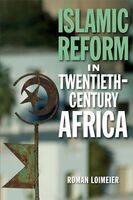 Islamic Reform in Twentieth-Century Africa
 Based on twelve case studies (Senegal, Mali, Nigeria, Niger, Chad, Sudan, Ethiopia, Somalia, Kenya, Tanzania, Zanzibar and the Comoros), this book looks at patterns and peculiarities of different traditions of Islamic reform. Considering both Sufi- and Salafi-oriented movements in their respective historical contexts, it stresses the importance of the local context to explain the different trajectories of development.
The book studies the social, religious and political impact of these reform movements in both historical and contemporary times and asks why some have become successful as popular mass movements, while others failed to attract substantial audiences. It also considers jihad-minded movements in contemporary Mali, northern Nigeria and Somalia and looks at modes of transnational entanglement of movements of reform. Against the background of a general inquiry into what constitutes ‘reform’, the text responds to the question of what ‘reform’ actually means for Muslims in contemporary Africa.
L'islam occupe traditionnellement une place importante dans l’histoire des populations du Niger. Mais sa progression s'est révélée à ce point fulgurante durant les toutes dernières décennies que, lors du recensement de 1988, près de 99pour cent des individus déclaraient s'y rattacher. Cette croissance permet certes de parler d'un '‘renouveau islamique" au Niger. Mais, paradoxalement, dans ce pays où l'islamisation ancienne ne fut pas véritablement synonyme d'arabisation, on peut se demander si cette progression de l'islam soutenue par des financements étrangers (surtout lybiens et saoudiens) ne pourrait pas être vue aussi comme le moment de l'éclatement de son monolithisme ancien. L'auteur de cet article s'interroge à ce sujet au travers de ce que deviennent les structures de l'éducation post-coloniale; au travers aussi de l'activisme de certains pays arabes qui, au Niger, favorisent l'émergence d'une “contre-élite" qui remet en cause l'ordre occidental de l'Etat hérité de la colonisation française. Il évoque aussi les effets de la libéralisation politique qui a permis un multipartisme dont le monolithisme religieux ancien n'est pas sans connaître les retombées: plusieurs courants de pensée islamique, avec leurs spécificités et leurs contradictions, deviennent clairement visibles. C'est enfin l'expression de plus en plus massive des divers courants islamiques dans les médias (y compris les médias d'Etat) qui retient son attention. L'auteur note que, jusqu'ici, le pouvoir en place n'a pas voulu voir dans cette effervescence islamique une véritable menace pour lui. Il pense toutefois qu’il pourrait y avoir là une certaine cécité intellectuelle. Car l'idée de Jihad n'est pas absente de l'action de certains mouvements islamistes du Niger, comme cela a pu se percevoir dans les discussions publiques au sujet de la laïcité de l'Etat et du projet de Code de la famille.
This paper provides a glimpse of Islamic scholarship in Mirriah, Niger Republic, at a particular point in time, 1974–1975, before some of the latest currents of religious unrest erupted in West Africa. Through interviews with local scholars, it examines the degree to which they participated in a West African “core curriculum” shared with other Islamic scholars across the Sahel. It also explores the history of the malamai class in Mirriah, noting significant ties to the Bornu empire. Both the ruling dynasty and Mirriah itself also exemplify the process of “becoming Hausa”: people of diverse origins have come to define themselves as Hausa, adopting the Hausa language and the religion of Islam.
Benin has a distinctive Islamic school system, constantly evolving since the colonial period: Besides the Coranic schools, which are still the basic instance of religious socialization, écoles arabes were established since independence, and furthermore there is an increase in écoles franco-arabes since the past ten years. This type of school combines religious and secular education. In the process of change in the educational system teachers are considered to be the key actors and initiators. This paper traces the development of the Islamic educational system by using the example of the city of Djougou in northern Benin. It aims to analyze the motivations of teachers in this arena and explores to what extent their self-image and their understanding of ′good education′ has changed. Particular attention will be paid to those teachers who are graduates from Islamic universities abroad. These so-called arabisants have access to strong social networks and use the existing educational structures to gain and maintain social and political influence,
This article posits that a new and important transformation is occurring in Sahelian society. Westerners have tended to see the rise of “Islamism” as just another rejection of globalization and modernization. This article argues that another interpretation is possible, one that looks at the rise of movements like Izala as an attempt of embryonic Hausa capitalists to become part of globalization by substituting a much more individualized set of beliefs and behaviors for the older social and normative constructs of “traditional” Hausa society that obliged them to limit their accumulation of capital.
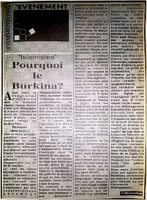 Islamistes : pourquoi le Burkina?
 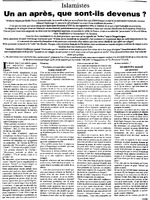 Islamistes : un an après, que sont-ils devenus?