 Conférence-débat au CCA : le dialogue interreligieux et le développement en question
  Conférence-débat du comité international pour l'expansion de l'islam à Sokodé
  Conférence-débat du FONZAB autour du Ramadan : s'abstenir à tout prix
 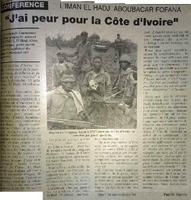 Conférence. L'iman El Hadj Aboubacar Fofana : "J'ai peur pour la Côte d'Ivoire"
 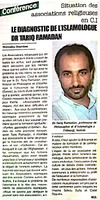 Conférence. Situation des associations religieuses en C.I. : le diagnostic de l'islamologue Dr Tariq Ramadan
  Confessions religieuses au Bénin : demain, un colloque pour repréciser le contenu de la laïcité
 Religious communities in Côte d’Ivoire have received state operating FM radio frequency concessions. Thus appear in the Ivorian media space and especially in Abidjan, Radio Espoir and the Voix de l’Evangile of the Catholic Church, Radio Al Bayan of the Muslim Community of Côte d'Ivoire and Fréquence Vie of Protestant and evangelical churches. With varying opportunities, the three radios will evolve in two specific socio-political contexts. The first '90 to 2000 is marked by the quest for democracy. The second, from September 2002, is marked by a political and military crisis. These two periods also correspond to two generations of leaders and managers. In this situation of social crisis and widespread political, religious radios become spaces of collective expression and distribution channels appreciated by the population.
 Conflit armé en Côte d'Ivoire : Mme Gbagbo et les musulmanes échangent
  Conflit au Proche-Orient : les cadres musulmans du Togo ont prié pour la paix
  Conflit entre musulmans et roscruciens : "Nous sommes opposés à toutes formes de violence" déclare le Grand conseiller de la Rose Croix
  Conflit entre musulmans sunnites à Man : le directeur général des cultes échoue dans la médiation
 The shaykh Sidi Mohammad Ben Abdallah, also known under the name shaykh Lakhdar was the initiator of the eleven jawaharatu-l-kamali prayer of the tijaniyya muslim group at nioro du Sahel in the former french Sudan. That was in 1909. This singular branch of the tijaniyya is also linked to the name of the shaykh Hamahoullah or Hamallah who was the follower and the successor of the shaykh Lakhdar. From the political point of view, the emergence of the hamawiyya or hamallisme, squares with the setting up of the colonial administration after the conquest, and from the religious point of view, to the end of the jihad and the acceptance of the colonial situation by many muslim leaders. The refusal by the shaykh Hamahoullah of a colonial compromise and the activities of the hamawi, placed the tijaniyya hamawiyya in a warring situation against the french administration between 1925 and 1948. Following a conflict between several moorish tribes in the nioro and assaba districts in august 1940, the colonial administration took the advantage to put down the hamawiyya. This resulted in the confinement of the hamawiyya top leaders in various african prisons and in the death in prison in january 1943 of Hamahoullah. However, the hamawi took the advantage of the decolonization process in the late 1940s with the creation of political parties to develop new prospects and move towards the urban centres. In the post-colonial states, the attitude of tijaniyya hamawiyya zealots is devided between the reconciliation with the national umma and a rigid moralist position which would give it the image of a fundamentalist sect.