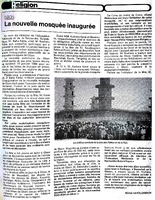
 Gbon : la nouvelle mosquée inaugurée
 In 1929, French colonial officials in Mauritania began monitoring a young man named Yacouba Sylla, the leader of a religious revival in the town of Kaédi. A Sufi teacher (shaykh), Yacouba Sylla had incurred the hostility of local administrators and the disdain of Kaédi's elite for preaching radical reforms of social and religious practice and for claiming authority out of proportion to his age and his rather minimal formal education. He claimed to derive his authority instead from a controversial shaykh named Ahmed Hamallah, then in exile from his home in Nioro, French Soudan (now Mali).
Among the principle inhabitants of the northern Togolese town of Sansanne Mango, the Anufom, only the members of one of the forty named lineages possess a ‘genealogy’ which purports to extend to ancestors born significantly prior to 1764, the year in which the forbears of the Anufom overthrew the Gurma inhabitants of the village of Kondjoko and established their military camp on its site. This aberrant genealogy of the lineage Kambaya is also of interest in that it consists, in its greater part, of two written documents, the only example of the use of Arabic script for this purpose that has been discovered in northern Togo.
Burkina Faso is an exception in the Sahel in that no politicisation and ideological radicalisation of Islam has taken shape in the public space. This paper – the first version of a chapter in an upcoming book – analyses both the causes and the implications of this fact. The historical analysis of the formative process of the Burkinabe nation reveals that Islamisation is a recent development in the country as compared to other parts of the Sahel. It came about as a result of the colonial transformation of societies in the area of future Burkina Faso, in the first half of the twentieth century and progressed in competition with Catholicism. While Islam later became the country's majority religion, the singular aspects of Burkina Faso's history – again, relative to its neighbours – have created a society marked by religious pluralism, and a very specific form of ‘consensual secularism.' In this context, an Islamic public space has emerged where various doctrinal currents – modernist reformists, Wahhabis, Sufis – struggle to assert themselves, but which leads to an enduring combination of subordination to and partnership with Burkina's successive regimes, especially as influential Muslim merchants largely control the all-important trade economy of the country. This result does not imply that Muslims in Burkina are politically quiescent, but that they tend to mobilise politically not as Muslims, but as citizens of Burkina, as is testified by the country's stormy political history. The case therefore teaches us to avoid essentialising Muslims' existence in the political arena.
Cette étude s'inscrit dans la continuité des travaux dirigés depuis 1997 par madame DorierApprill (Laboratoire Population Environnement et Développement), dans le cadre du projet de recherche VILLENDEV, portant sur les dynamiques territoriales dans la région de PortoNovo Cotonou. Ce travail a été construit dans le cadre d'une réflexion et d'enquêtes collectives, menées par des enseignant chercheurs (Dorier Apprill, Barbier, Bridier) ainsi que d'une vingtaine d'étudiants. Notre travail s'appuie sur les données collectées depuis 1997 (données statistiques, enquêtes, cartes...). Dans le cadre de ce travail, mon apport à été de mettre à jour l'inventaire effectué en 2003 sur les lieux de cultes de l'Islam à Porto-Novo, ainsi qu'apporter une analyse à différentes échelles sur les espaces de l'Islam dans la capitale.