| "Médias et sécurité" : programme d'urgence du CSC |
21 avril 2017 |
|
| "Médias et Sécurité" : un programme d’urgence pour un traitement adapté de l’information liée aux questions sécuritaires |
20 avril 2017 |
|
| "Menaces" sur la paix sociale : des médiateurs pour sauver le Burkina? |
30 janvier 2014 |
|
| "My Religiosity is Not in My Hijab": Ethics and Aesthetics among Salafis in Niger |
2021 |
|
| "Nas air", nouvel avionneur |
10 septembre 2013 |
|
| "Native" Conversion to Islam in Southern Côte d'Ivoire: The Perils of Double Identity |
2012 |
This article presents a synthetic, historical-cum-anthropological overview of the collective trajectory of Ivoirian converts to Islam from southern autochthonous lineages who can be referred to—albeit unsatisfyingly—as ‘native' Muslims. It focuses on what is effectively an invisible and silent minority within southern native groups and the majority Dioula Muslim society alike: a community that has barely received any attention from social scientists despite the transformative impact of its slow but steady Islamization process. The study aims first at shedding light on salient socio-religious and political aspects of this group's development, from colonial to postcolonial times. Given that this plural group is situated at the crossroads of various ethnic, national, and religious controversies, having enflamed Côte d'Ivoire in olden days as much as in recent years, the article eventually makes use of this group's distinct prism to question the contested Ivoirian interface between Islam, ethnic geography, and nationalism at large, and attempt some nuanced answers. |
| "Nord musulman et Sud chrétien" : les moules médiatiques de la crise ivoirienne |
2003 |
Media reports of the rebellion tearing apart C?te d'Ivoire portray the conflict as a rift between a Muslim North and a Christian South. They repeatedly refer to the armed conflict in religious terms by describing the country as split between a government-held area in the Christian and animist South and a rebel-held area in the Muslim North." This cultural/geographical description of the conflict inhibits our understanding of the situation. These newspaper reports echo the divisive statements of politicians and thus serve to widen rifts. In sum, the religious and geographical simplifications by the media do not contribute to our understanding of the conflict. Rather, they insidiously exacerbate it by reinforcing stereotypes and deepening social and political divisions. |
| "Nous avons intérêt à ce que la Tabaski se fête dans le strict respect des mesures barrières", dixit le missionnaire islamique Arif Mahmood |
24 juillet 2020 |
|
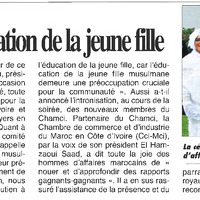 "Nuit de reconnaissance" : le Chamci va soutenir l'éducation de la jeune fille "Nuit de reconnaissance" : le Chamci va soutenir l'éducation de la jeune fille |
7 juin 2017 |
|
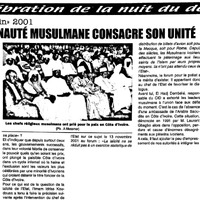 "Nuit du Destin" 2001 : la communauté musulmane consacre son unité "Nuit du Destin" 2001 : la communauté musulmane consacre son unité |
13 décembre 2001 |
|
| "Opération mouton" de Tabaski : une action sociale en direction des musulmans |
2 août 1983 |
|
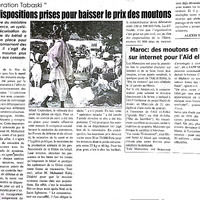 "Opération Tabaski" : des dispositions prises pour baisser le prix des moutons "Opération Tabaski" : des dispositions prises pour baisser le prix des moutons |
7 janvier 2006 |
|
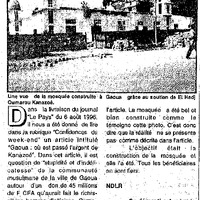 "Où est passé l'argent de Kanazoé" : un démenti de Gaoua "Où est passé l'argent de Kanazoé" : un démenti de Gaoua |
27 août 1996 |
|
 "Père Jacques", un sage entre deux feux sacrés "Père Jacques", un sage entre deux feux sacrés |
16 septembre 2002 |
|
| "Police islamique" à Pouytenga : des révélations qui interpellent le gouvernement |
25 avril 2018 |
|
| "Political" Islam in Senegal and Burkina Faso: Contrasting Approaches to Mobilization since the 1990s |
2017 |
This article compares the strategies devised by two Salafi-oriented Islamic associations, the Senegal's Jamaatou Ibadou Rahmane (JIR) and the Burkina Faso's Mouvement Sunnite (MS). Drawing on extensive field research conducted between 2002 and 2013, it shows that both organizations have been engaged since the 1970s in a similar legitimacy-building process, using contrasting strategies. The JIR intends to build a more constructive relationship with the State and the brotherhoods, while still continuing to cast a critical eye on these two groups. In Burkina Faso, recurring leadership crises and violent incidents has sapped a great deal of the MS's energy. It therefore has to regain visibility and legitimacy by maintaining a certain distance from political debates. The comparison shows that political Islam has entered in both countries a transitional phase that took into account the emergence and perhaps even the consolidation of a cultural and religious form of citizenship. |
 "Prémices" sans per diem "Prémices" sans per diem |
16 septembre 2002 |
|
 "Radicalismes islamiques" existe-t-il une international islamique ? "Radicalismes islamiques" existe-t-il une international islamique ? |
1 octobre 1986 |
|
 "Ramadan pour les malades" édition 2012 : 2000 plats distribués aux malades "Ramadan pour les malades" édition 2012 : 2000 plats distribués aux malades |
22 août 2012 |
|
| "Rencontre des cadres musulmans" 2023 : relever les défis nationaux |
9 octobre 2023 |
|
| "Renforcer la coopération arabo-africaine" : le Dr Ayari (président de la BADEA) à Abidjan |
13 mai 1983 |
|
| "Rien ne peut justifier le terrorisme" (Imam Dicko) |
16 août 2022 |
|
| "Sécurité islamique" à Pouytenga : «Elle n'est pas armée et n'a pas vocation à être un groupe d'autodéfense» |
27 mars 2018 |
|
| "Sexualité en Islam" : appliquer l'acte dans toute sa spiritualité conseille Mme Cissé aux jeunes musulmans |
22 août 1990 |
|
 "Simon Compaoré et Halidou Ouédraogo doivent se réconcilier" selon l'imam Moussa Doulkoum de la mosquée de Gounghin "Simon Compaoré et Halidou Ouédraogo doivent se réconcilier" selon l'imam Moussa Doulkoum de la mosquée de Gounghin |
14 mai 1999 |
|